
Bread and Circuses & Push‑Notification Purposes
What to do when purpose has become a product, and why the body is the only place it can be reclaimed.

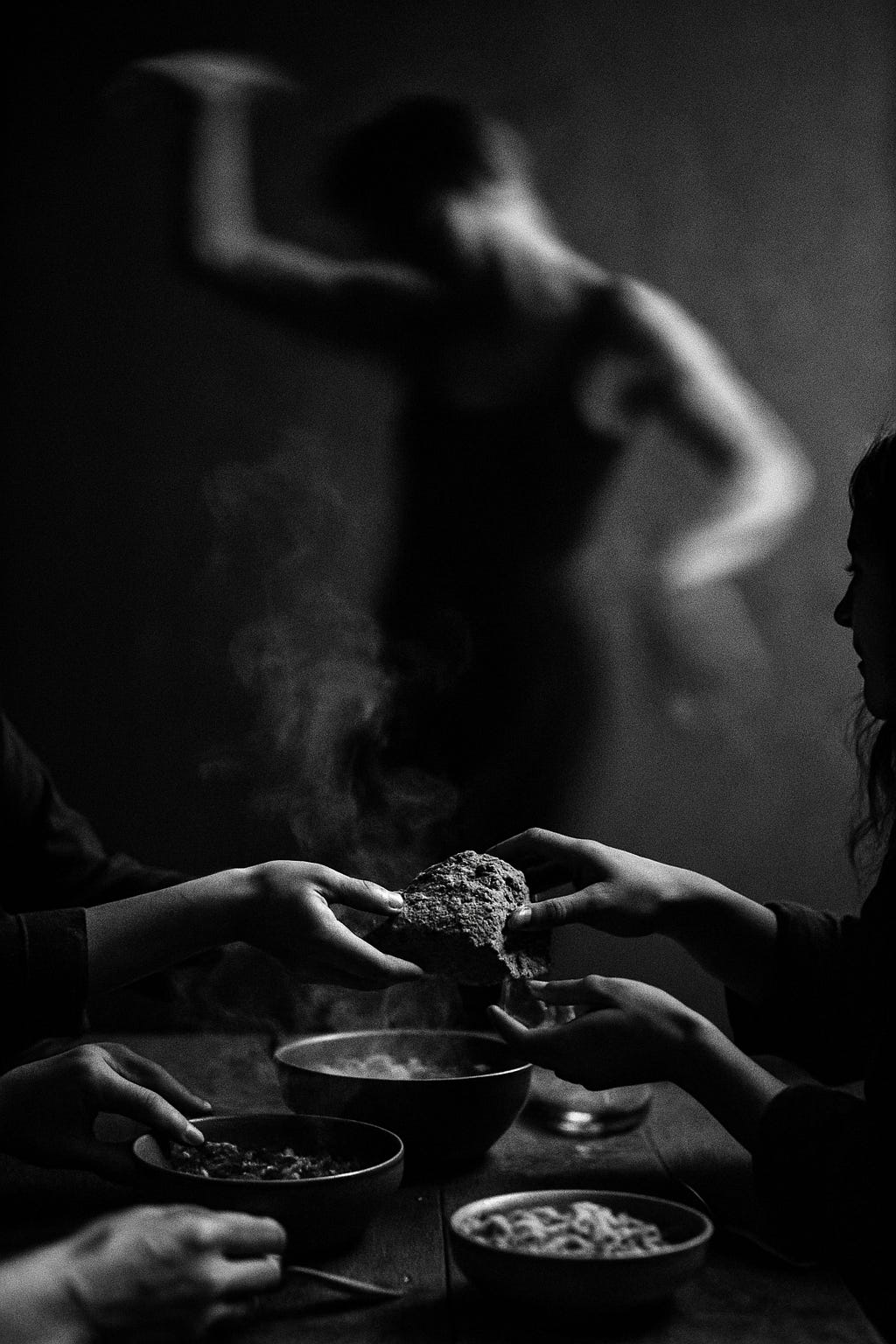
I thought I needed another cleanse. A retreat. A way to get away from it all…
There are seemingly a million enticing options promising curated serenity, organic meals, and purpose-driven community. Or maybe there was an app that would help me redo my morning routine? That would surely cure me.
It was late, I was tired, and I was grasping. Anything to “fix” my discomfort.
Until I sat with my own feelings and remembered something I’d forgotten for so much of my life. Something I’m seeing people increasingly forget: that you can’t scroll, click, buy, travel, party, meditate, retreat, or cleanse your way to a greater state of being.
The collective vibe is racing toward an all-time low, and spiritual capitalism is taking off as people seek to get a hit of anything to make themselves feel better, more certain, or more “on track.”
In ancient Rome, emperors pacified the restless public with panem et circenses: bread and circuses. Free grain and gladiator games. Keep them full, keep them entertained, and they’ll stop asking questions. Two thousand years later, the menu has changed, but the tactic hasn’t. Except this time, the bread is frictionless: next-day delivery, dopamine-optimized routines, purpose-branded wellness apps. The circuses are infinite: scrollable, shoppable, algorithmically tailored. They promise fulfillment while gently pacifying us.
But beneath this cultural convenience lies a deeper loss that’s harder to name. In a world where institutions are fragmenting, work is increasingly gigified, and AI models can simulate just about everything, something hollow underneath it all echoes louder by the day.
It’s the “meaning crisis.” First coined in 2016 by cognitive scientist John Vervaeke, the term describes the pervasive sense of emptiness, isolation, and disconnection that characterizes modern society. As traditional structures like religion, community, stable employment erode, we find ourselves increasingly unmoored and grasping for anchors. While anxiety and depression spike, loneliness is becoming an epidemic, and existential uncertainty is quietly creeping into our daily lives.
And Capitalism, here to save the day, has a product for every pain. Into this existential void countless brands have rushed, promising personalized purpose delivered straight to your inbox. HR departments roll out meaning-making workshops; CEOs tout corporate mission statements as paths to self-actualization. PwC even has a Chief Purpose Officer. Mindfulness has become a subscription model, with meditation another KPI to track. Everything is “measureable,” trackable. The SaaS-ification of our lives is making us crave dashboards for our spiritual growth. We want proof that we’ve been good! Our search for meaning, once a profound, embodied exploration, has quickly become yet another commodity: streamlined, measured, and marketed.
We think we're satiating our need for meaning, but we’re actually deepening our hunger, feeding it fast food dressed as enlightenment. Meanwhile, where is the world going? What’s real anymore? What atrocities are happening under our noses? It’s painful to keep our hearts and eyes open, but we have to.
Meaning isn't something you can outsource or buy off a shelf. It isn't an app you can download or a program you can complete. Real meaning emerges from lived experience, from the felt sense of connection with oneself and others, from participation in rituals older than commerce itself. It begins in the body, in our breath and our blood, and in tangible acts of relational care and creation.
Research backs what we know to be true in our bodies. Neuroscientist Dr. Kelly McGonigal emphasizes in her work that the hormones oxytocin and serotonin, which is associated with bonding, trust, and well-being, are primarily released through physical presence and direct human connection. Touch, movement, and shared experiences are the mediums through which authentic happiness and fulfillment often arise.
Philosopher and author Alan Watts also god here decades ago, when he wrote: “The meaning of life is just to be alive. It is so plain and obvious and so simple. And yet, everybody rushes around in a great panic as if it were necessary to achieve something beyond themselves.” When we do something simple like walk barefoot on cold soil or lend a helping hand to a friend, we stop the rush and remember we’re already home.
Communities and cultures around the world demonstrate this every day. From the rhythmic dances of West African drum circles that ignite communal joy, to the warmth of cooking and sharing meals in Mediterranean cultures, to the quiet presence cultivated in Japanese tea ceremonies, each local tradition reminds us that real meaning emerges through shared, sensory experiences. Those of us who “escape” go camping or to festivals every now and again often do so just to tap back into that simple, tribal nature. But why is it that so many of us in the Western world are seeking those escapes, rather than living the way we want to here and now?
The commodification of meaning is still on the upswing, and we’ve been asking for it. According to Google Trends, searches for “purpose in life” surged ~3× at the pandemic’s onset (no surprise), but five years later, they are still hovering 60% above their pre-COVID baseline. Evidence that the craving has not yet subsided.
Soon, with the rise of AI, many of us will encounter what could be called the “job-shaped hole:” the psychic vacuum left as AI sweeps away livelihoods we believed defined us. Those who have already experienced displacement from their roles for one reason or another have tasted this vertigo, but as automation improves, we'll experience it en masse, accelerating the fragmentation of identities that had long been anchored to our work. In this reshuffling, some may also find their “god-shaped hole,” the deep spiritual yearning we all have that technology and commerce promised (but failed) to fill. I think many of us will find ourselves grappling once again with the oldest questions of who we truly are and what we genuinely trust. We may not know exactly what is coming but will have to find faith, not just in something larger, but also in ourselves and each other. We will have to remember that beneath the roles we lost, beneath every identity we once wore, we were always there, intact and waiting to be recognized.
By treating meaning as just a product, we commit what philosopher Gilbert Ryle termed a "category mistake:” confusing the lived, emergent quality of experience with something that can be packaged and sold. Philosopher Maurice Merleau-Ponty reminds us that "the body is our general medium for having a world," suggesting that authentic purpose arises through direct, sensory engagement.
The way out of the Purpose-Industrial Complex and into a future that we are prepared for IS NOT a subscription, or another digital badge celebrating empty progress. It’s a return to tangible acts of human connection: building something with your own hands, sharing meals prepared together, sitting in silence with others. Real meaning emerges from the body through presence and authentic expression. It’s creating the thing you wish existed, like being weird and having a drum circle on the floor in your apartment. It’s taking risks like going alone to events and being tender with strangers. It’s writing a mediocre blog post for yourself and no one else. It’s being in touch with your body so you know what works for you and what doesn’t; what is pleasurable and what is painful; and what means most to you, and why.
Coming back to our physical selves is a reclamation as we remember, finally, that we were always enough, just as we are. Fully inhabited and uninhibited.